


PROPASTEEL VCI
High-strength anticorrosive plastic film
The thin strength for heavy industry: ultra-resistant film for pipes, coils and machinery with sharp edges
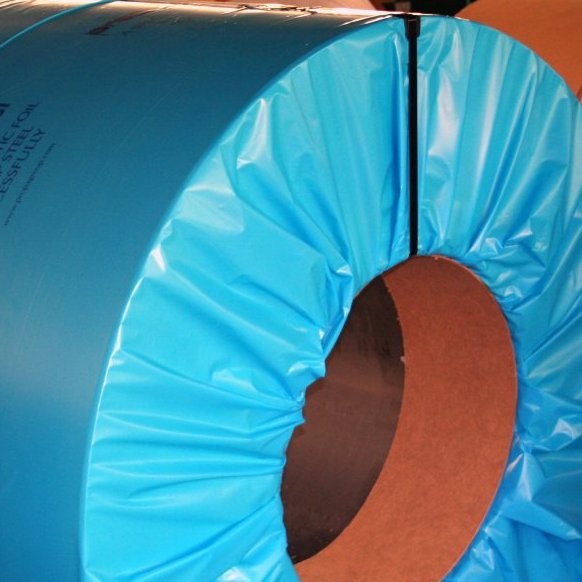
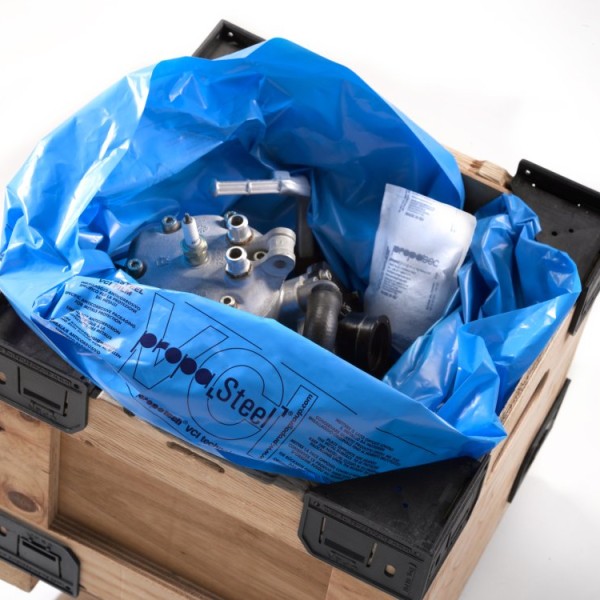
PROPASTEEL VCI is a new generation coextruded plastic film, made with special technological resins that provide exceptional puncture resistance and cutting resistance capabilities. This innovative product has been specifically developed for the metallurgical and steel industry, where traditional plastic films cannot withstand the mechanical stress caused by pipes, coils, machinery with sharp or protruding parts. When treated with the PROPATECH VCI system, it combines the mechanical protection of packaging with excellent anticorrosive protection, creating a complete solution for the preservation of metal products.
The innovative characteristics of PROPASTEEL revolutionize the approach to industrial packaging: it is 100% recyclable unlike traditional laminated products, easily weldable to offer hermetic seals and highly economical thanks to high yield per kilogram. Despite its contained thickness, it provides superior resistance that makes it particularly competitive in terms of cost per square meter. It definitively solves the problems of breakage during handling of heavy loads and angular items, can be used both manually and automatically, and offers low permeability for prolonged protection.
The PROPASTEEL PLUS version represents the most advanced evolution with superior mechanical performance, very low permeability and greater anticorrosive protection.
PROPASTEEL is normally supplied in rolls but upon request sheets, bags, bellows covers or other formats can be produced. PROPASTEEL can be customized both graphically and in terms of coloring (standard color blue).
Problems solved by this product


VCI stands for Volatile Corrosion Inhibitor.
Desiccant bags absorb humidity in the package, hence they reduce risk of oxidation. Still, to protect a material against corrosion, it is necessary to use a Propagroup VCI product as well.
The quantity of VCI to be used in order to effectively protect goods against corrosion depends on many factors, being the most relevant: shipping time, external conditions (e.g. by sea, by land), and type of product. We strongly recommend to contact us in order to determine the most efficient solution and design the most appropriate package.
Some anticorrosive VCI products, like paper and certain films, work well in contact with the material to be protected, whereas VCI diffusers, for example, do work at a distance in order to saturate the inside of packaging with the VCI substance and protect the goods against corrosion attacks. VCI products are very often used together to protect metals both in contact and at a distance and to better preserve their quality over time.
It is not necessary, as PROPAGROUP VCI film and paper leave no residuals on goods. In fact, because of the absence of oil and grease, PROPATECH VCI is one of the client’s favourite products: they receive a qualitatively perfect, clean and ready to use product.
Corrosion is a chemical reaction between a metal and its environment which results in a gradual destruction of metal and degradation of its properties.
It is very important to wear protective gloves as skin acidity can start oxidation of metal.
There are 2 types of VCI paper: double-faced paper, impregnated on both sides, or one-sided PE coated paper. This latter is active only on one side, while the other consists of a barrier film able to keep the VCI within the package.
VCI film is always active on one-side.
On both VCI paper and film the active side (to be oriented toward the metal) is easily distinguishable, as it is opposite to the printed side.
Anticorrosion protection
To ensure proper protection of metal goods during the transportation phases, it is necessary for the packing to be made with suitable anticorrosion products. Propagroup is the leader in designing and developing antioxidant treatments able to effectively resolve the various problems of companies that transport and store metal goods, offering valid and safe anti-rust treatments in the Italian and international markets.
Antioxidant films, paper, and bags
Propagroup has launched on the market VCI anticorrosion packing items to guarantee adequate protection of metals. The most-used products are: paper; shrink films; bags; and covers for protecting metal automotive components such as engine blocks, transmissions, gearboxes, and brake discs, as well as steel coils, entire machines, and metal products in general.
Completely recyclable items
Continuous investments in research and development combined with the expertise and professionalism acquired over more than 40 years in the market have allowed us to expand our market not only in Italy and Europe, but all over the world. The packing we offer is ideal for solving any problem regarding corrosion, humidity, or condensate, and also includes many anti-impact products. We operate in full respect of the environment, and we develop completely recyclable products that are entirely compliant with all environmental laws, regulations, and standards applicable to companies.
There are different types of VCI depending on metal to protect.
The chemical or electrochemical reaction between a material, usually a metal, and its environment that produces a deterioration of the material and its properties.
Diffusion is the volatile distribution of VCI molecules into the packaging.
PROPATECH VCI products for the protection against corrosion are free from nitrites.
Nitrites are made of a nitrogen atom and two oxygen atoms negatively charged and it can be found in some anticorrosive VCI products on the market. Its presence has to be allowed and declared from the producer.
A corrosion reaction in which the corroded metal forms an oxide; usually applied to reaction with a gas containing elemental oxygen, such as air.
Transformation from a solid to a gaseous state of VCI molecules starting from the protective material (paper, film, diffusers, foams, etc...).
VCI is a Volatil Corrosion Inhibitor that can sublimate, from a solid to a gas state, and form a thin invisible layer able to neutralize corrosive agents such as: water vapour, oxygen, saline atmosphere, sulphurous gases and the most common industrial environmental pollutants present in the air.
The Volatile Corrosion Inhibitor is a chemical substance that inhibits electrochemical oxidation of metals in reaction with an oxidant such as oxygen.
Source: wikipedia | license


