

PROPABOL VCI
Anti-corrosive bubble wrap polyethylene
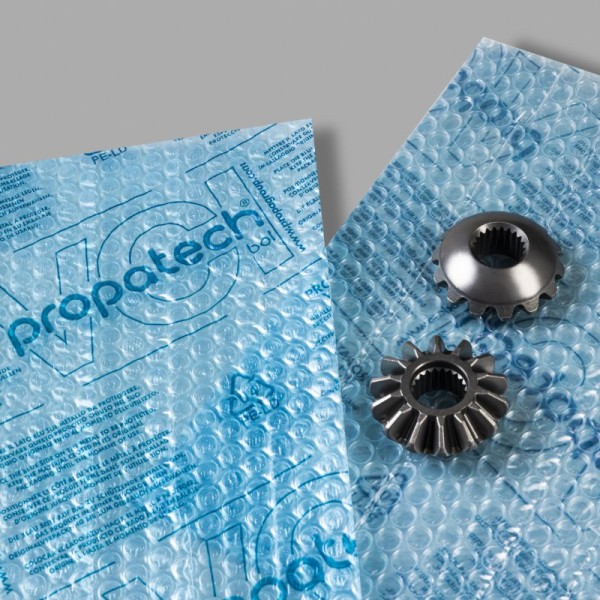
Comprehensive triple-action protection: anti-corrosive, shock-resistant and scratch-resistant in a single transparent material.
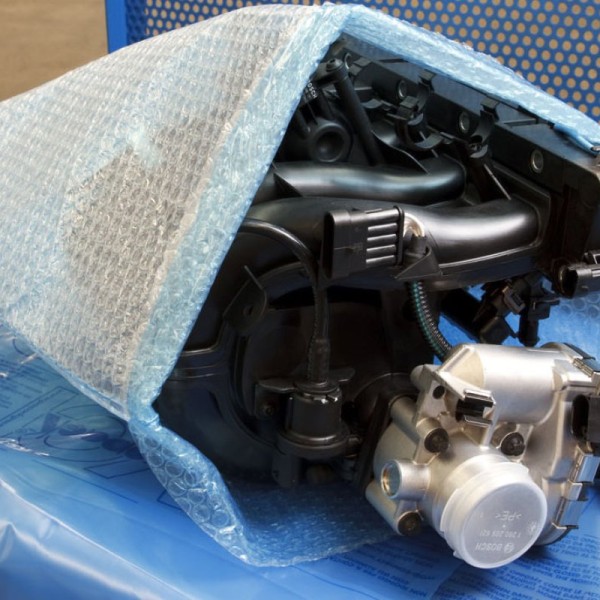
PROPABOL VCI represents a revolutionary innovation in the industrial protection sector, created through the intelligent coupling of bubble wrap polyethylene with PROPATECH VCI FILM added with volatile corrosion inhibitor. This unique solution combines three fundamental protective functions in a single material: anti-corrosive protection thanks to VCI molecules, impact protection through the cushioning effect of air bubbles, and protection from friction between parts during handling. All while maintaining complete transparency that allows correct positioning of manufactured goods and facilitates control operations.
This innovative product revolutionizes the traditional approach to metal protection, definitively replacing old oiling and greasing systems with a more practical, economical and sustainable solution. PROPABOL VCI eliminates the need for post-opening pickling operations, providing manufactured goods immediately ready for use without oily residues to remove. It is completely recyclable, reduces operational costs and processing times, and offers superior protection even for delicate products that require both anti-corrosive preservation and mechanical cushioning. Available in rolls, formats and bags, it represents the ideal solution for companies seeking maximum efficiency with minimum environmental impact.
Problems solved by this product


There are 2 types of VCI paper: double-faced paper, impregnated on both sides, or one-sided PE coated paper. This latter is active only on one side, while the other consists of a barrier film able to keep the VCI within the package.
VCI film is always active on one-side.
On both VCI paper and film the active side (to be oriented toward the metal) is easily distinguishable, as it is opposite to the printed side.
VCI is a volatile substance so, once the packaging is opened, it volatilize from metal in one or two hours and it will not leave resuduals.
Desiccant bags absorb humidity in the package, hence they reduce risk of oxidation. Still, to protect a material against corrosion, it is necessary to use a Propagroup VCI product as well.
It is very important to wear protective gloves as skin acidity can start oxidation of metal.
VCI (Volatile Corrosion Inhibitor) can be used for all products that need a corrosion protection inside the packaging such as steel coils, automotive spare parts, engines, complete machineries and all kind of metal parts.
Anticorrosive VCI products used in the packaging are not dangerous for the health of people because VCI is a physiologically inactive substance. Any problem of eye or skin irritation have been found in people that directly worked with packagings treated with VCI. In any case, because VCI is a chimical substance, is suggested the use of gloves when in contact with the anticorrosive packaging. We also suggest to always ask for the safety data sheet to our customer care before using anticorrosive Propatech VCI products for your packagings.
Please contact us: export@propagroup.com
VCI stands for Volatile Corrosion Inhibitor.
It is not necessary, as PROPAGROUP VCI film and paper leave no residuals on goods. In fact, because of the absence of oil and grease, PROPATECH VCI is one of the client’s favourite products: they receive a qualitatively perfect, clean and ready to use product.
VCI is a complex combination of substances which sublimate and form a thin invisible layer able to neutralise corrosive agents, such as water vapour, oxygen, salty air, sulfur-based gases, and polluting agents commonly present in the air.
Ferrous metals contain iron, for example steel, whilst non-ferrous metals do not contain iron, for example zinc, magnesium, and copper.
The chemical or electrochemical reaction between a material, usually a metal, and its environment that produces a deterioration of the material and its properties.
Diffusion is the volatile distribution of VCI molecules into the packaging.
PROPATECH VCI products for the protection against corrosion are free from nitrites.
Nitrites are made of a nitrogen atom and two oxygen atoms negatively charged and it can be found in some anticorrosive VCI products on the market. Its presence has to be allowed and declared from the producer.
A corrosion reaction in which the corroded metal forms an oxide; usually applied to reaction with a gas containing elemental oxygen, such as air.
Transformation from a solid to a gaseous state of VCI molecules starting from the protective material (paper, film, diffusers, foams, etc...).
VCI is a Volatil Corrosion Inhibitor that can sublimate, from a solid to a gas state, and form a thin invisible layer able to neutralize corrosive agents such as: water vapour, oxygen, saline atmosphere, sulphurous gases and the most common industrial environmental pollutants present in the air.
The Volatile Corrosion Inhibitor is a chemical substance that inhibits electrochemical oxidation of metals in reaction with an oxidant such as oxygen.
Source: wikipedia | license


