PROPADRY
Revolutionary desiccant tray system for containers that neutralizes condensation and protects goods during maritime transport.
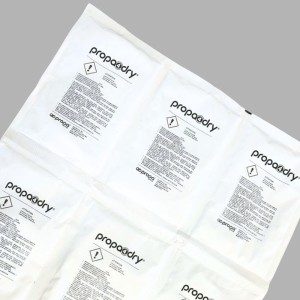
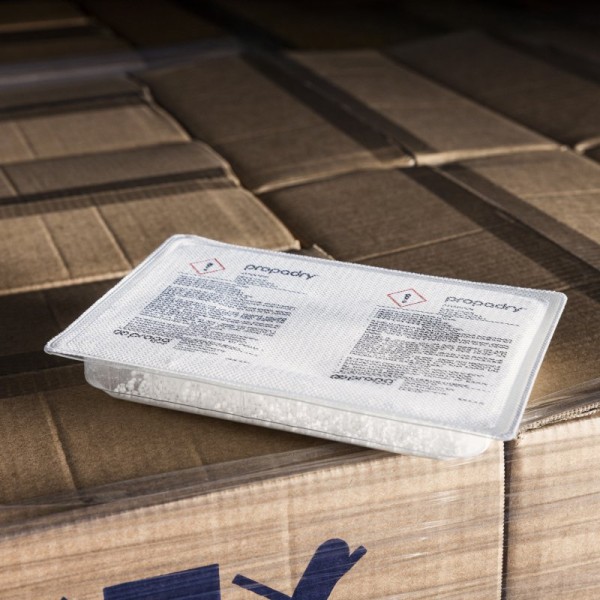
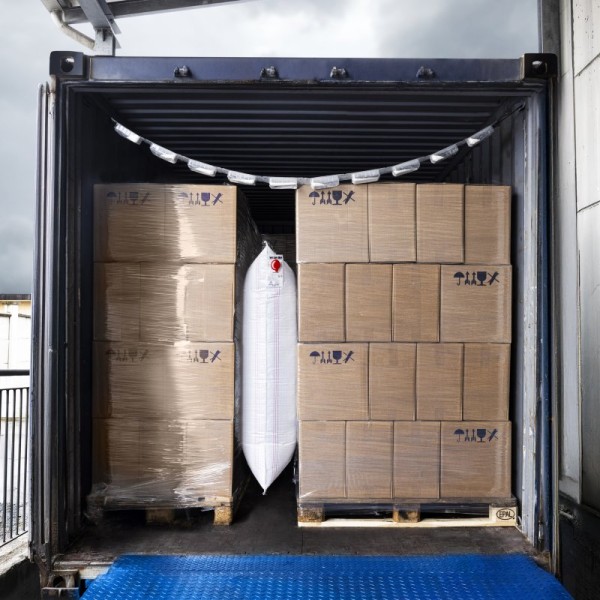
PROPADRY represents a technological revolution in humidity control for containers and packaging. This innovative desiccant tray system has been designed to neutralize condensation formation, protecting the integrity of goods during long journeys and storage phases. The patented technology uses a special breathable membrane that attracts humidity-saturated air, while the internal hygroscopic salt transforms and retains it inside the tray in liquid or gel form, depending on whether it is Propadry or Propadry Plus.
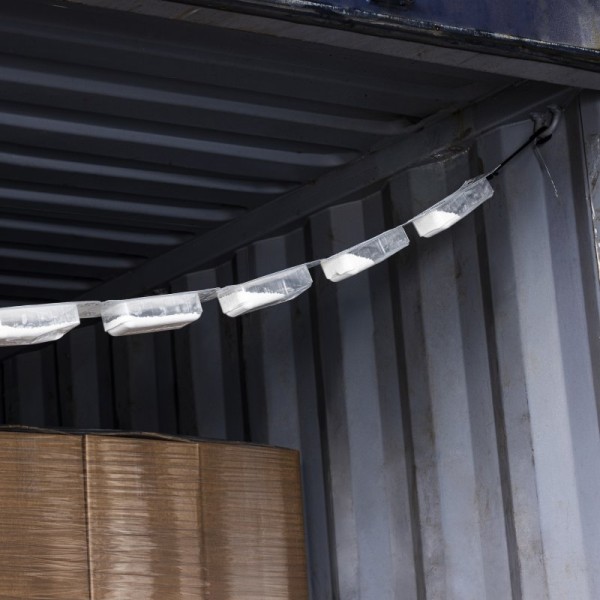
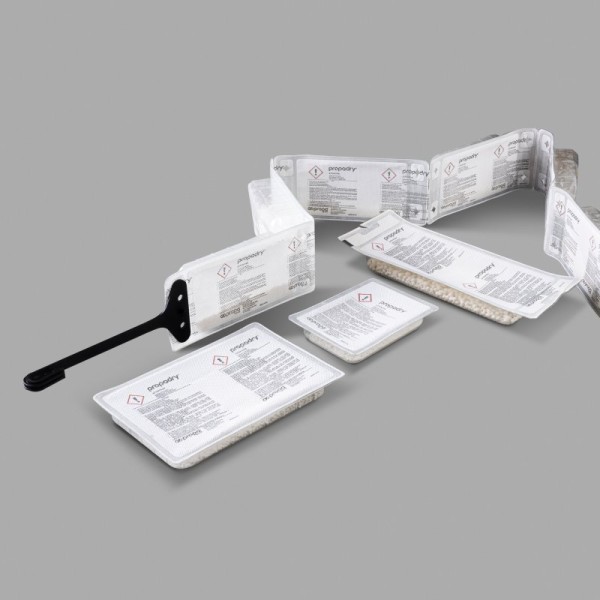
Propadry absorbs up to four times its weight in humidity, preventing the harmful evaporation and condensation cycles that cause stains, corrosion and deterioration of goods. PROPADRY CHAIN introduces a further innovation with the patented chain system that reduces installation times in containers to just a few minutes, optimizing operational efficiency. Environmentally friendly and DMF-free (Dimethyl Fumarate), PROPADRY offers total safety for operators and goods, products arrive to the end customer in perfect condition and disputes are drastically reduced, increasing end customer satisfaction.
Problems solved by this product


Anti-humidity desiccants are indispensable for guaranteeing suitable protection and preservation of the products over time. Propagroup has made a name for itself in the market due to its line of desiccants for controlling and protecting against the elements during the transportation and handling of goods. Propagroup developed anti-humidity products, because they are aware that changes in temperature can damage finished products and create considerable hardship for companies and their customers.
These products were developed to prevent and avoid this type of damage to goods, providing the tools necessary for keeping under control and eliminating any harmful agents. The range of desiccants free of dimethyl fumarate (DMF) includes:
• Propasec, which has a large capacity of absorption at a limited cost, is ideal for packaging electronic, pharmaceutical, and food items, etc.
• Propasil, desiccant bags or capsules of silica gel, used mainly in the chemical and pharmaceutical industries.
• Bags consisting of synthetic zeolites (molecular sieve) used when a large amount of moisture needs to be absorbed very quickly.
• Propacontainer, in 1 or 2 kg bags, for keeping freight containers below the dew point.
• Propadry and Propadry Plus, to prevent the formation of condensate in freight containers and in packing.
Propagroup also offers humidity and temperature indicators, barrier material, and Stirofilm. The barrier material Propametic is obtained by lamination and acts as a barrier against water vapor. Stirofilm is a technical multilayer film used to cover and line transport and storage crates; it is also extremely resistant in case of stacked crates.
During transportation and storage of goods it is necessary to adopt appropriate technical procedures to resolve humidity and condensation problems, which could irreparably damage the materials contained in packaging. Propagroup has been present on the market for more than 40 years, specialized in the manufacture of innovative and functional products and systems to solve problems with condensation; they are a qualified reference point for the large number of companies operating in the most diverse industrial and trade sectors.
The Propagroup product range was designed and developed to find an effective response to all the problems with humidity, including items for calculating humidity and temperature, ambient condition recorders, desiccant products such as silica gel, and much more. Specifically, it developed a valid solution for preventing the formation of condensation inside medium and large crates and freight containers: the Propadry anti-humidity tray, which employs three simple operations to eliminate humidity in closed spaces:
1. Propadry absorbs the humidity that passes through a breathable membrane.
2. The molecules contained in the mixture transform the condensation into water.
3. The water is then trapped in the tray.
The products and systems of Propagroup, which are located in Rivoli (province of Torino), are designed and built to prevent damage resulting from the presence of humidity and condensation. In this manner crates always reach their destination in perfect condition, with a considerable reduction in complaints.
For many years now Propagroup has also been specialized in the production of desiccants, which are indispensable for preventing the circulation of humidity inside packages and containers or for preventing the formation of condensate in closed spaces, thereby protecting the quality of your products. Desiccant salts hold an important position among Propack's products, and they comprise a wide range of desiccant products of the highest quality, including desiccant clay, silica gel desiccant, and molecular sieves.
The air humidity together with the humidity created by the evaporation of the water contained in the load tend to form a true tropical microclimate in closed spaces. A consequence of this situation is water vapor entering the packages being transported. The condensate that is created and dries causes moisture to form continuously on the goods and results in them becoming stained, often damaging them permanently. The production of Propagroup desiccant salts prevents condensate from forming, thereby becoming indispensable for protecting and preserving the quality and characteristics of your products.
Propagroup is also specialized in the production of desiccants for freight containers to protect the materials from the formation of condensate.
Desiccant salts for packaging are the most practical and flexible solution for preventing the circulation of humidity inside closed spaces. Propagroup possesses many years of experience in the production of desiccant salts that are able to absorb and neutralize humidity and condensate inside packages or containers. Our desiccants include an enormous line of products that, besides guaranteeing a high degree of protection, also ensure complete respect for the environment, combining excellent absorption capacities with very reasonable costs.
In the packaging field is the reduction of the dew point inside the packaging or container to eliminate humidity or guarantee preservation of qualities and properties of use of the product packed. Desiccant bag is an example of product absorbing humidity inside the packaging.
In physical chemistry absorption is the incorporation of a substance in one state into another of a different state (e.g. liquids being absorbed by a solid or gases being absorbed by a liquid).
Source: wikipedia | license
In the field of packaging protection we can use adsorbtion to define:
- the diffusion of VCI molecules inside the packaging
- the humidity attraction process from the raw material, like for example unpacked argile or silicagel
Adsorption is the adhesion of atoms, ions, biomolecules or molecules of gas, liquid, or dissolved solids to a surface.
Source: wikipedia | license
In the protective packaging sector we can speak of adsorption to define:
- the phenomenon of diffusion of VCI molecules in the packaging
- the process of moisture attraction by raw materials, such as clay or unpackaged silica gel
In the physical chemistry field, adsorption is generally a particular type of absorption that occurs only at the surface.
Source: wikipedia | license
Bentonite is a clayey mineral made of montmorillonite, calcium or sodium. In the packaging field bentonite is used as desiccant in bags of non-woven tissue to eliminate humidity inside packagings.
Propasecard humidity indicators are cobalt chloride free.
Cobalt chloride is an inorganic compound of cobalt and chlorine, with the formula CoCl2. It is usually supplied as the hexahydrate CoCl2·6H2O, which is one of the most commonly used cobalt compounds in the laboratory. The hexahydrate is deep purple in color, whereas the anhydrous form is sky blue. A blend would be mauve. Because of the ease of the hydration/dehydration reaction, and the resulting color change, cobalt chloride is used as an indicator for water in desiccants. Niche uses include its role in organic synthesis and electroplating objects with cobalt metal. It has been classified as a Substance of very high concern by the European Chemicals Agency.
Propagroup product range for humidity protection also includes a specified desiccant to be used inside container, PROPADRY.
An intermodal container or freight container is a reusable transport and storage unit for moving products and raw materials between locations or countries; the terms container or box may be used on their own within the context of shipping.
Source: wikipedia | license
A desiccant is a hygroscopic substance that induces or sustains a state of dryness (desiccation) in its local vicinity in a moderately well-sealed container. Commonly encountered pre-packaged desiccants are solids, and work through absorption or adsorption of water, or a combination of the two. Desiccants for specialized purposes may be in forms other than solid, and may work through other principles, such as chemical bonding of water molecules. Pre-packaged desiccant is most commonly used to remove excessive humidity that would normally degrade or even destroy products sensitive to moisture. Drierite, Silica gel, calcium sulfate, calcium chloride, montmorillonite clay, and molecular sieves are commonly used as desiccants.
Source: wikipedia | license
Desiccant clay is the name commonly used to define calcium bentonite (montmorillonite), a naturally occurring material that is chemically inert, non-corrosive and composed mainly of calcium and magnesium aluminum silicates.
Desiccant clay is the common name to call calcium bentonite (montmorellonite), a material of natural origin and chemically inert, non-corrosive and mainly consisting of magnesium and calcium silicate aluminium.
Humidity is a term for the amount of water vapor in air, and can refer to any one of several measurements of humidity. Formally, humid air is not "moist air" but a mixture of air and water vapor, and humidity is defined in terms of the water content of this mixture, called the Absolute humidity. In everyday usage, it commonly refers to relative humidity, expressed as a percent in weather forecasts and on household humidistats; it is so called because it measures the current absolute humidity relative to the maximum. Specific humidity is a ratio of the water vapor content of the mixture to the dry air content. The water vapor content of the mixture can be measured either as mass per volume or as a partial pressure, depending on the usage.
A molecular sieve is a material containing tiny pores of a precise and uniform size that is used as an adsorbent for gases and liquids. Molecules small enough to pass through the pores are adsorbed while larger molecules are not. It is different from a common filter in that it operates on a molecular level and traps the adsorbed substance. For instance, a water molecule may be small enough to pass through the pores while larger molecules are not, so water is forced into the pores which act as a trap for the penetrating water molecules, which are retained within the pores. Because of this, they often function as a desiccant. A molecular sieve can adsorb water up to 22% of its own weight.[1] The principle of adsorption to molecular sieve particles is somewhat similar to that of size exclusion chromatography, except that without a changing solution composition, the adsorbed product remains trapped because in the absence of other molecules able to penetrate the pore and fill the space, a vacuum would be created by desorption. Often they consist of aluminosilicate minerals, clays, porous glasses, microporous charcoals, zeolites, active carbons, or synthetic compounds that have open structures through which small molecules, such as nitrogen and water can diffuse. Molecular sieves are often utilized in the petroleum industry, especially for the purification of gas streams and in the chemistry laboratory for separating compounds and drying reaction starting materials. The mercury content of natural gas is extremely harmful to the aluminium piping and other parts of the liquefaction apparatussilica gel is used in this case. Methods for regeneration of molecular sieves include pressure change (as in oxygen concentrators), heating and purging with a carrier gas (as when used in ethanol dehydration), or heating under high vacuum. Temperatures typically used to regenerate water-adsorbed molecular sieves range from 130 °C to 250 °C
Source: wikipedia | license
Silica gel is most commonly encountered in everyday life as beads packed in a vapor-permeable plastic. In this form, it is used as a desiccant to control local humidity in order to avoid spoilage or degradation of some goods. Because of poisonous dopants (see below) and their very high absorption of moisture, sílica gel packets usually bear warnings for the user not to eat the contents. If consumed, the pure silica gel is unlikely to cause acute or chronic illness, but would be problematic nonetheless. Food-grade desiccant should not include any poisons which would cause long-term harm to humans if consumed in the quantities normally included with the items of food.
Source: wikipedia | license
In many items, moisture encourages the growth of mold and spoilage. Condensation may also damage other items like electronics and may speed the decomposition of chemicals, such as those in vitamin pills. Through the inclusion of silica gel packets, these items can be preserved longer.